New Energy-Efficient Neural Coding Strategy for Power-Law Input Distributions
Abstract
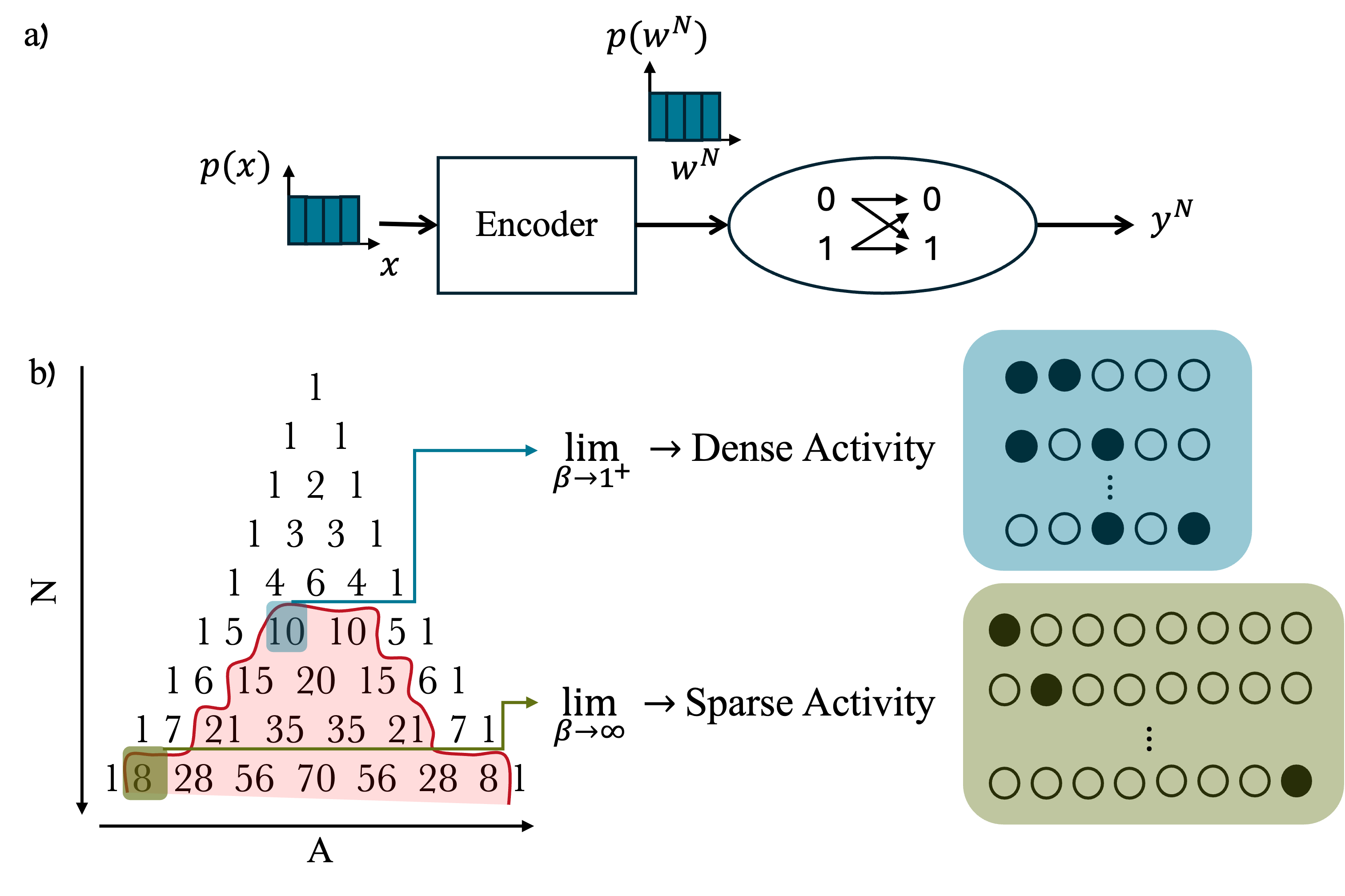
Neuronal signaling accounts for the majority of the brain’s energy consumption, suggesting that neural processing has evolved to favor energy-efficient coding strategies. Previous models based on uniformly distributed inputs have demonstrated that sparse activation patterns enhance energy efficiency. However, many real-world inputs follow power-law distributions, which are not captured by these models. Our research addresses this limitation through two goals: (1) to formally connect existing energy-efficient neural codes to coding schemes from information theory; and (2) to develop a probabilistically modulated coding framework that incorporates power-law input distributions, more accurately reflecting biologically plausible inputs. These findings also have practical implications for the design of neuromorphic systems, which operate under similar energy constraints.
Personal Outcome
My supervisor agreed to give me an exploratory project on topics about which I initially had only superficial knowledge. This pushed me far beyond my comfort zone and forced me to adapt my working methods.